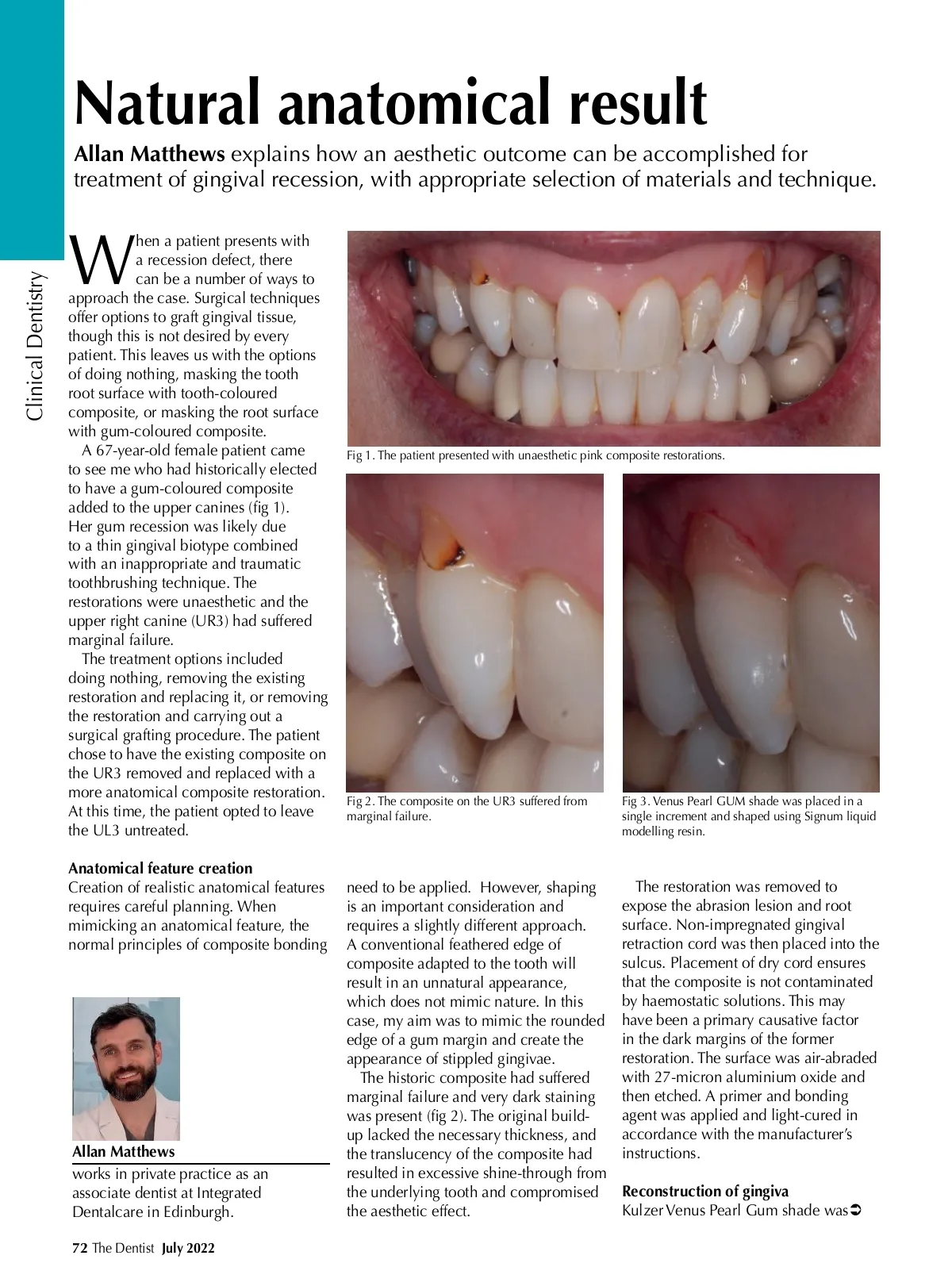
Natural anatomical result hen a patient presents with a recession defect, there can be a number of ways to approach the case. Surgical techniques offer options to graft gingival tissue, though this is not desired by every patient. This leaves us with the options of doing nothing, masking the tooth root surface with tooth-coloured composite, or masking the root surface with gum-coloured composite. A 67-year-old female patient came to see me who had historically elected to have a gum-coloured composite added to the upper canines (fig 1). Her gum recession was likely due to a thin gingival biotype combined with an inappropriate and traumatic toothbrushing technique. The restorations were unaesthetic and the upper right canine (UR3) had suffered marginal failure. The treatment options included doing nothing, removing the existing restoration and replacing it, or removing the restoration and carrying out a surgical grafting procedure. The patient chose to have the existing composite on the UR3 removed and replaced with a more anatomical composite restoration. At this time, the patient opted to leave the UL3 untreated. Anatomical feature creation Creation of realistic anatomical features requires careful planning. When mimicking an anatomical feature, the normal principles of composite bonding Allan Matthews explains how an aesthetic outcome can be accomplished for treatment of gingival recession, with appropriate selection of materials and technique. Clinical Dentistry W Fig 1. The patient presented with unaesthetic pink composite restorations. Fig 2. The composite on the UR3 suffered from marginal failure. Fig 3. Venus Pearl GUM shade was placed in a single increment and shaped using Signum liquid modelling resin. Allan Matthews works in private practice as an associate dentist at Integrated Dentalcare in Edinburgh. 72 The Dentist July 2022 need to be applied. However, shaping is an important consideration and requires a slightly different approach. A conventional feathered edge of composite adapted to the tooth will result in an unnatural appearance, which does not mimic nature. In this case, my aim was to mimic the rounded edge of a gum margin and create the appearance of stippled gingivae. The historic composite had suffered marginal failure and very dark staining was present (fig 2). The original build-up lacked the necessary thickness, and the translucency of the composite had resulted in excessive shine-through from the underlying tooth and compromised the aesthetic effect. The restoration was removed to expose the abrasion lesion and root surface. Non-impregnated gingival retraction cord was then placed into the sulcus. Placement of dry cord ensures that the composite is not contaminated by haemostatic solutions. This may have been a primary causative factor in the dark margins of the former restoration. The surface was air-abraded with 27-micron aluminium oxide and then etched. A primer and bonding agent was applied and light-cured in accordance with the manufacturer’s instructions. Reconstruction of gingiva Kulzer Venus Pearl Gum shade was
The Dentist July 2022: Page 72